

Nvidia GeForce RTX 3050 Ti Laptop GPU Review
The GeForce RTX 3050 Ti is a mainstream GPU for gaming laptops, sitting below the RTX 3060 in the product stack, and offer united states a follow up to final year'southward GTX 1660 Ti and GTX 1650 for laptops. With the graduation from GTX to an RTX product, this means we're set to proceeds ray tracing and DLSS features. The latter in particular should bring a squeamish heave for this popular segment.
The RTX 3050 Ti was announced alongside the RTX 3050 for laptops a couple of months ago, but with ongoing supply constraints, information technology's taken us a bit longer to get samples in mitt.

At the moment, pricing seems to be all over the place for laptops. Nvidia originally listed the RTX 3060 every bit destined for $1,000 laptops, with the RTX 3050 at $800 and presumably the RTX 3050 Ti sitting somewhere in between.
This would friction match the baseline prices of GTX 1660 Ti systems from previous generations. However these pricing targets are a bit optimistic, about realistic 3050 Ti organization configurations are in a higher place $1,000, though still $100-200 less than the exact same model with the RTX 3060 inside. It'southward a bit hard to compare generations correct now, but that should be a rough guide to where Nvidia are positioning this GPU.

The RTX 3050 Ti Laptop GPU is based on new GA107 silicon, which has yet to reach the desktop market. But equally usual, when the RTX 3050 Ti launches on desktop, information technology will likely perform differently to the laptop part with the same name.
Basic specifications comprise xx SMs for a total of 2560 CUDA cores, 20 RT cores and lxxx Tensor cores. Clock speeds up to 1695 MHz boost at 80W, or as low equally 1035 MHz for the 35W configuration, giving usa quite a wide power range of 35 to 80W.
In that location's likewise simply 4GB of GDDR6 memory on a 128-bit motorbus, clocked at 12 Gbps. Basically the 3050 Ti is designed to be two thirds of an RTX 3060 in its SM count and VRAM chapters.

Nvidia is also trying to cater to both regular gaming laptops, and ultraportable systems, with the RTX 3050 Ti'due south large power range including 35W models that previously would have been branded equally "Max-Q."
This makes it crucially important to check the power specifications of any laptop you're buying, every bit 80W models won't come close to 35W models in performance, and unfortunately Nvidia is using the aforementioned proper name for both. Today's test system is the XMG Core 17, a neat 17-inch gaming laptop with a focus on functionality and functioning.

I've been positively impressed with what XMG has provided in the by in terms of cooling, build quality and overall hardware. The Core 17 is no exception and it's a simple pattern built for value. If you're interested in this specific XMG model check it out here, nevertheless the findings from this review should apply to many RTX 3050 Ti laptops.
Internally, at that place is Core i7-11800H processor and 16GB of dual-channel DDR4-3200 retentiveness, good hardware choice that won't hinder performance. There'south also a 1080p 144Hz IPS display and 1TB of SSD storage. The GeForce RTX 3050 Ti inside runs at fourscore - 95W with dynamic heave enabled, and then we're getting a look at the highest power configuration Nvidia allows for this role. Resizable BAR is also supported.

The focus of this review will be on 1080p testing with Optimus enabled, which is the default configuration in well-nigh laptops that sees the GPU's output routed through the iGPU to the display. We've also tested at 1440p using an external display connected directly to the GPU, which gives u.s. the least limited experience at a college resolution. On to the charts...
Benchmarks
We'll boot things off with a look at Metro Exodus, running Ultra settings at 1080p. Here the RTX 3050 Ti performs roughly on par with the RTX 2060 in boilerplate frame rate, putting information technology slightly ahead of the GTX 1660 Ti, all with similar power limits.
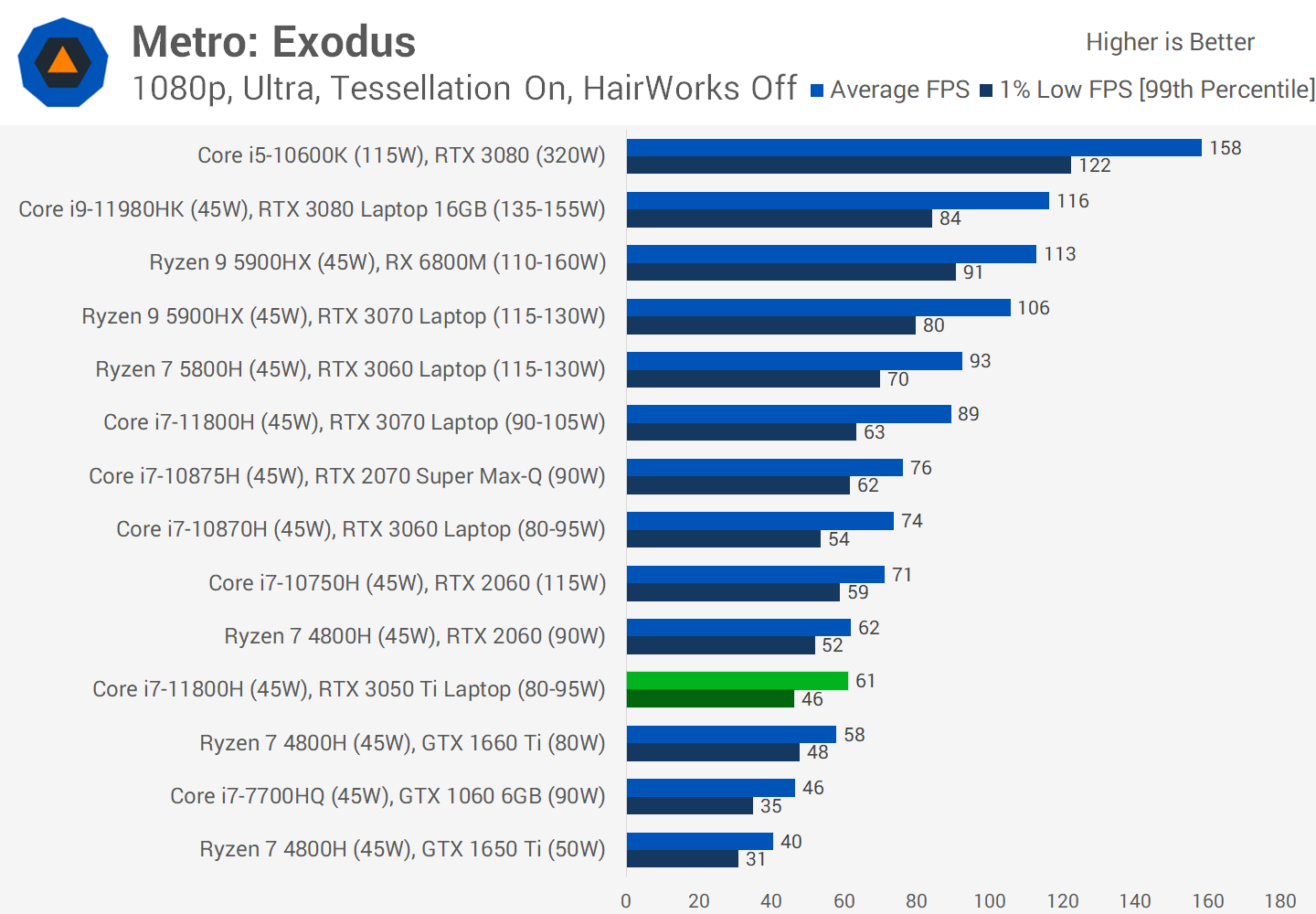
However the 3050 Ti does take the everyman one% low figure, despite having a powerful CPU that should non pose a CPU bottleneck for this class of GPU. In comparing to the RTX 3060, the 3050 Ti ends up 17% slower at the same power limit, and 34% slower when comparing the highest ability limits each GPU has to offer.
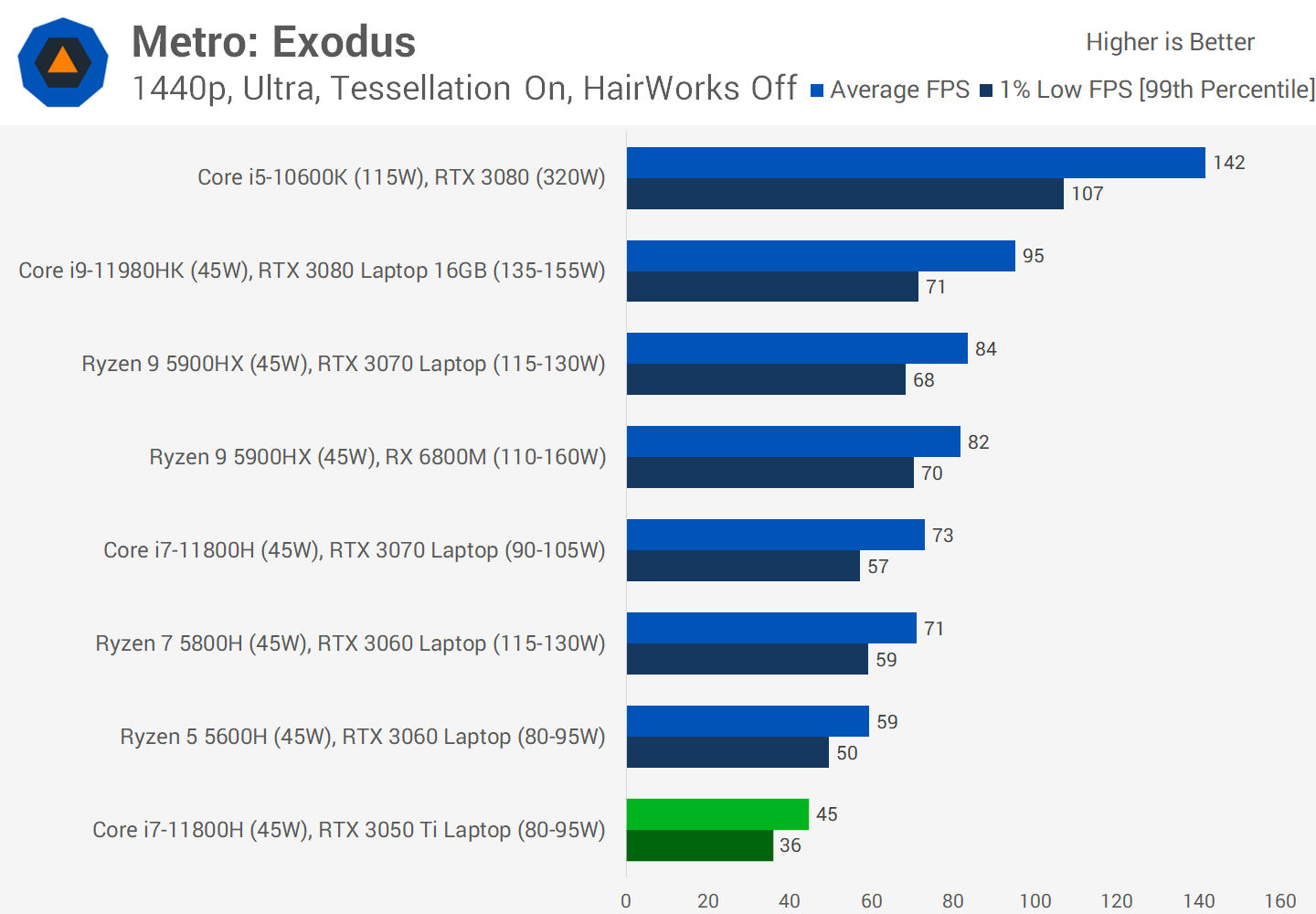
It'due south a similar state of affairs at 1440p. While the RTX 3050 Ti isn't badly unplayable, especially if you lot drib the quality settings from Ultra to High, this GPU however ends up 25% slower than the RTX 3060 when comparing 80W vs 80W configurations.
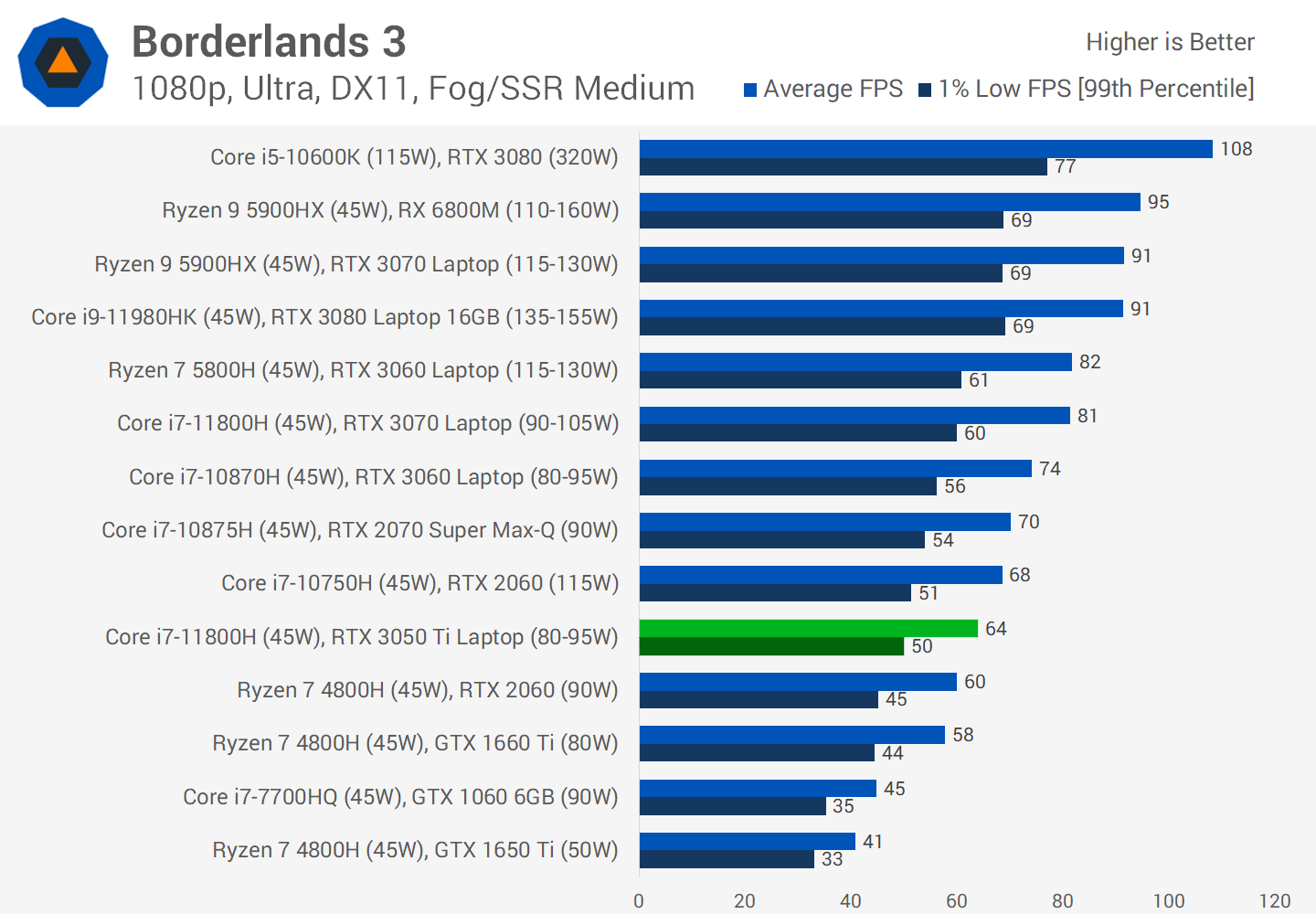
In Borderlands 3 tested using 1080p Ultra settings, the RTX 3050 Ti is faster than the 90W RTX 2060, a healthy seven percent faster in fact, though this reduces to a 7 per centum deficit when comparing to the 115W RTX 2060. With that said, we're looking at 11 percent faster performance than the GPU information technology's replacing, the GTX 1660 Ti, and 14% worse performance than the RTX 3060 at 80W.
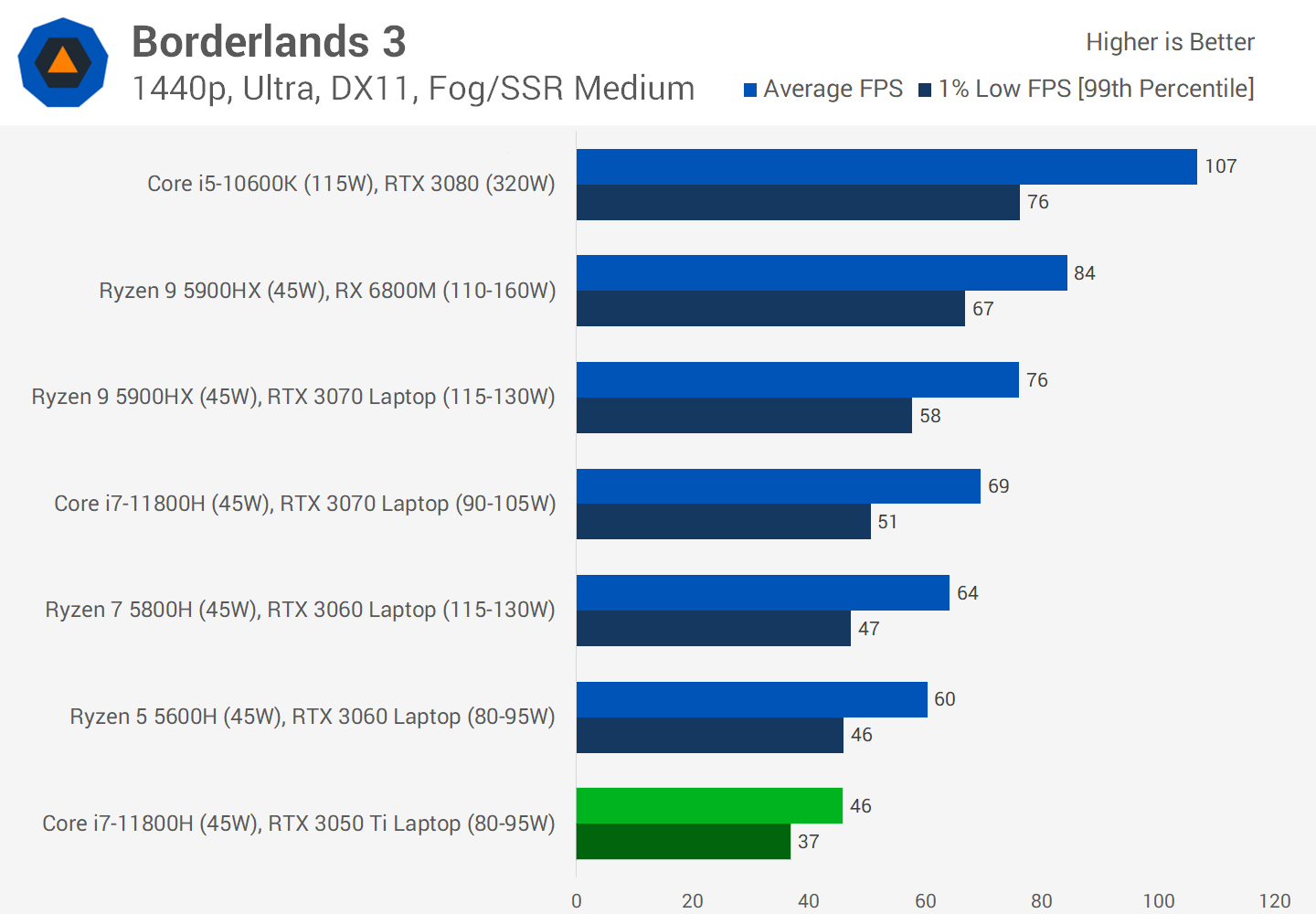
At 1440p once more yous tin can see the RTX 3050 Ti is a class backside its RTX 3060 compatriots. In this particular game, the college power RTX 3060 at 115W is 40% faster than the RTX 3050 Ti, which is a large performance increase though of form the college tier GPU does have fifty% more CUDA cores to become with its higher power limit.
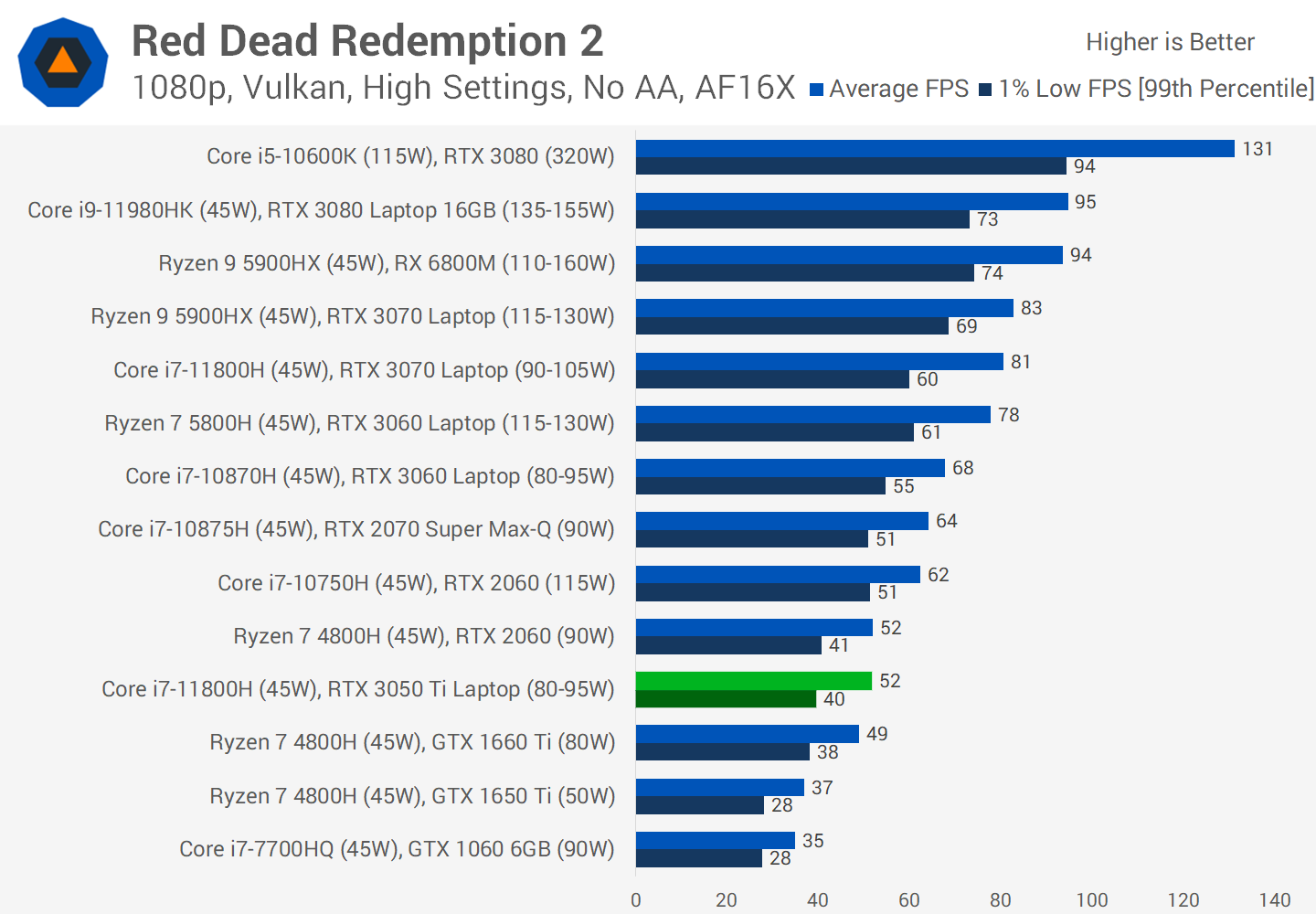
In Ruby-red Expressionless Redemption 2, the RTX 3050 Ti is again on par with the RTX 2060 90W configuration at 1080p using High settings. This places it slightly faster than the GTX 1660 Ti, about 6 percent faster in this title. While this is somewhat playable at 1080p, it's a clear grade below the RTX 3060, which offers 31% college frame rates even with the lower 80-95W ability model.
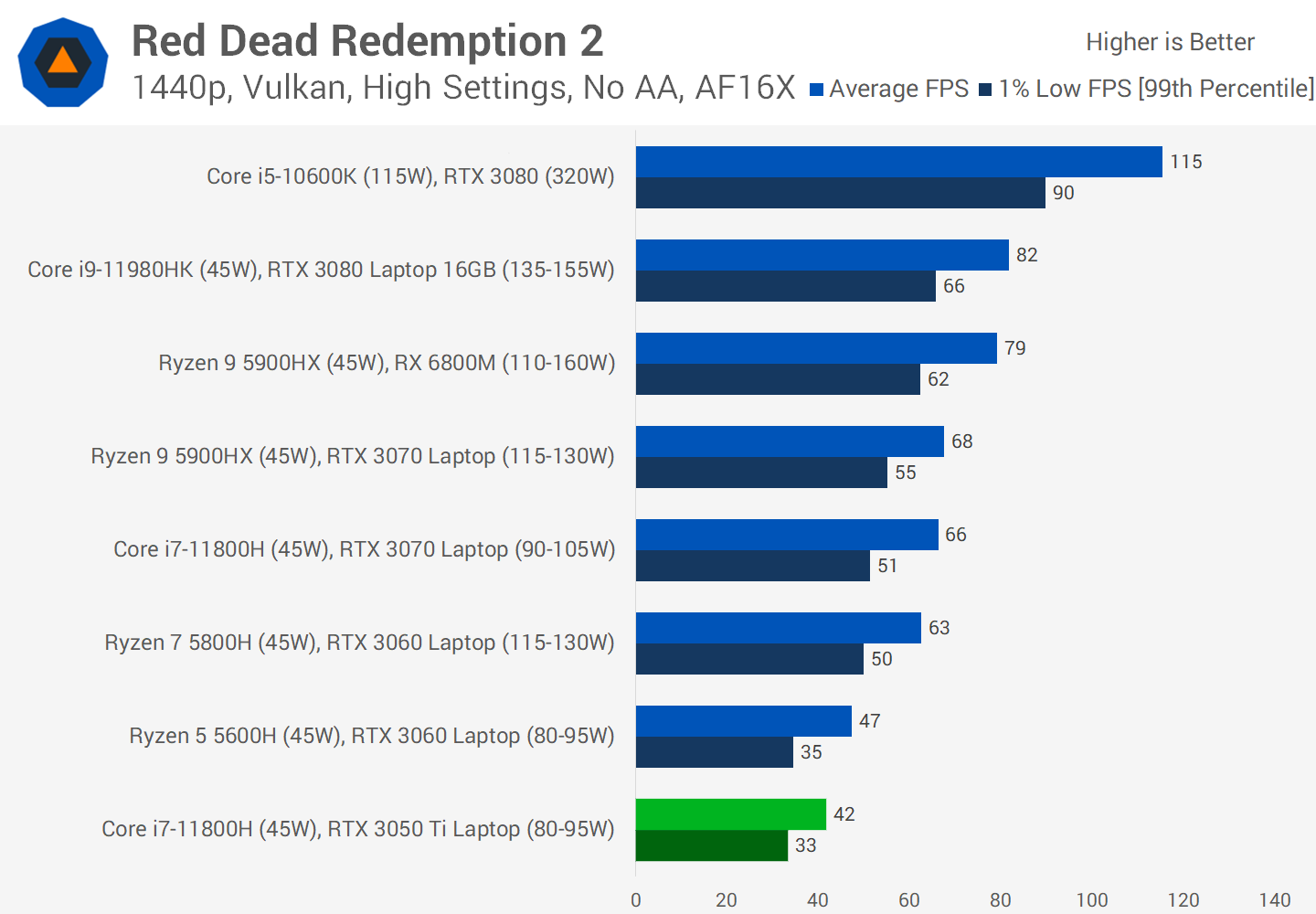
And then at 1440p, the RTX 3050 Ti struggles. It'south actually competitive with the RTX 3060 80W, simply well backside the higher power variant which can offer a 60 FPS experience at this resolution and quality settings.
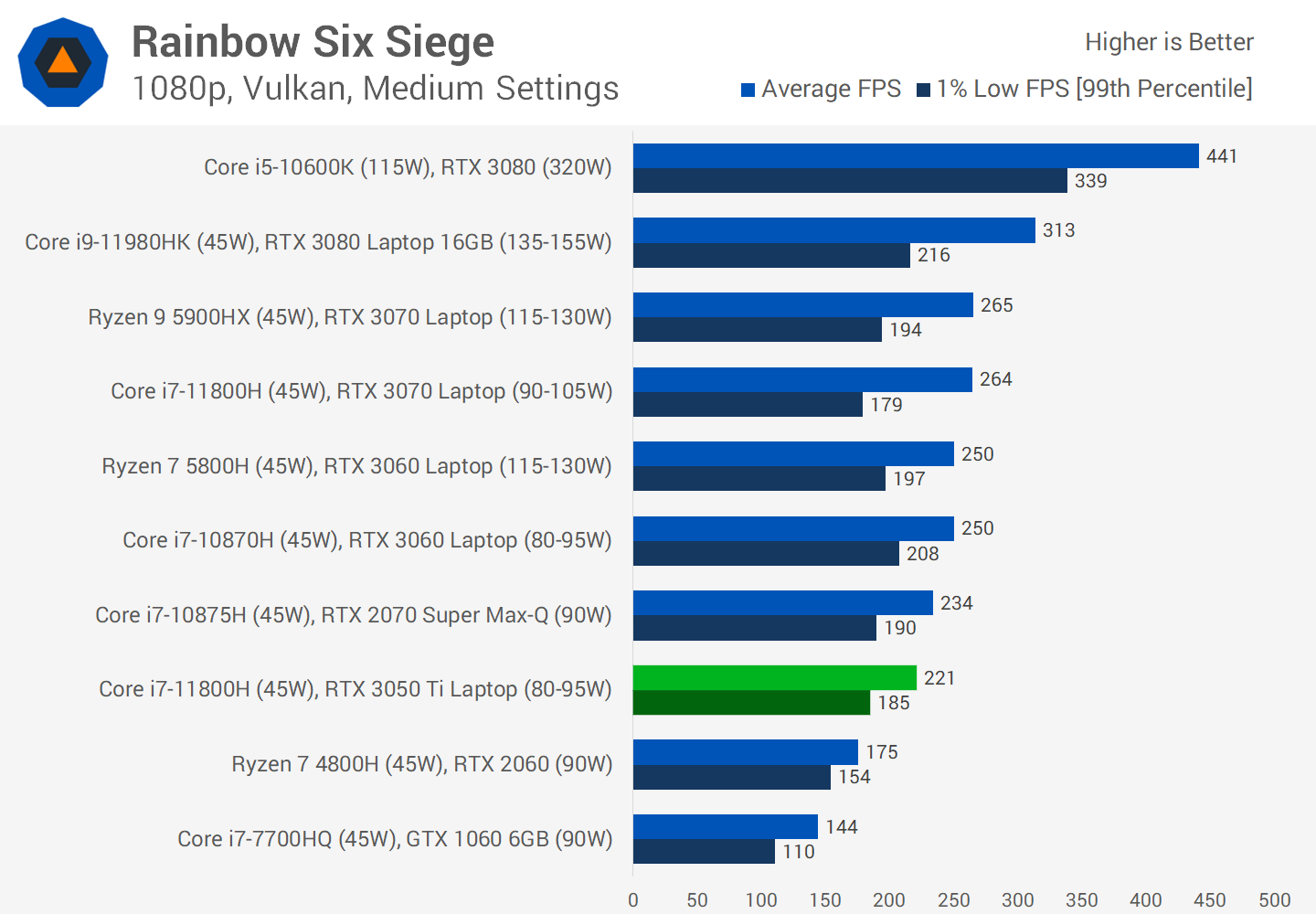
Rainbow Six Siege running at 1080p Medium settings gives united states a good look at how GPU limited yous'll typically be in competitive shooters. The 3050 Ti is powerful enough that it's not too far off laptops that are fully CPU limited with more powerful hardware, but it's also just slightly GPU limited, offering 220 FPS versus the 260+ FPS we know this CPU can handle. All the same this is clearly excellent performance for a laptop, the 3050 Ti is more than than plenty for this game.
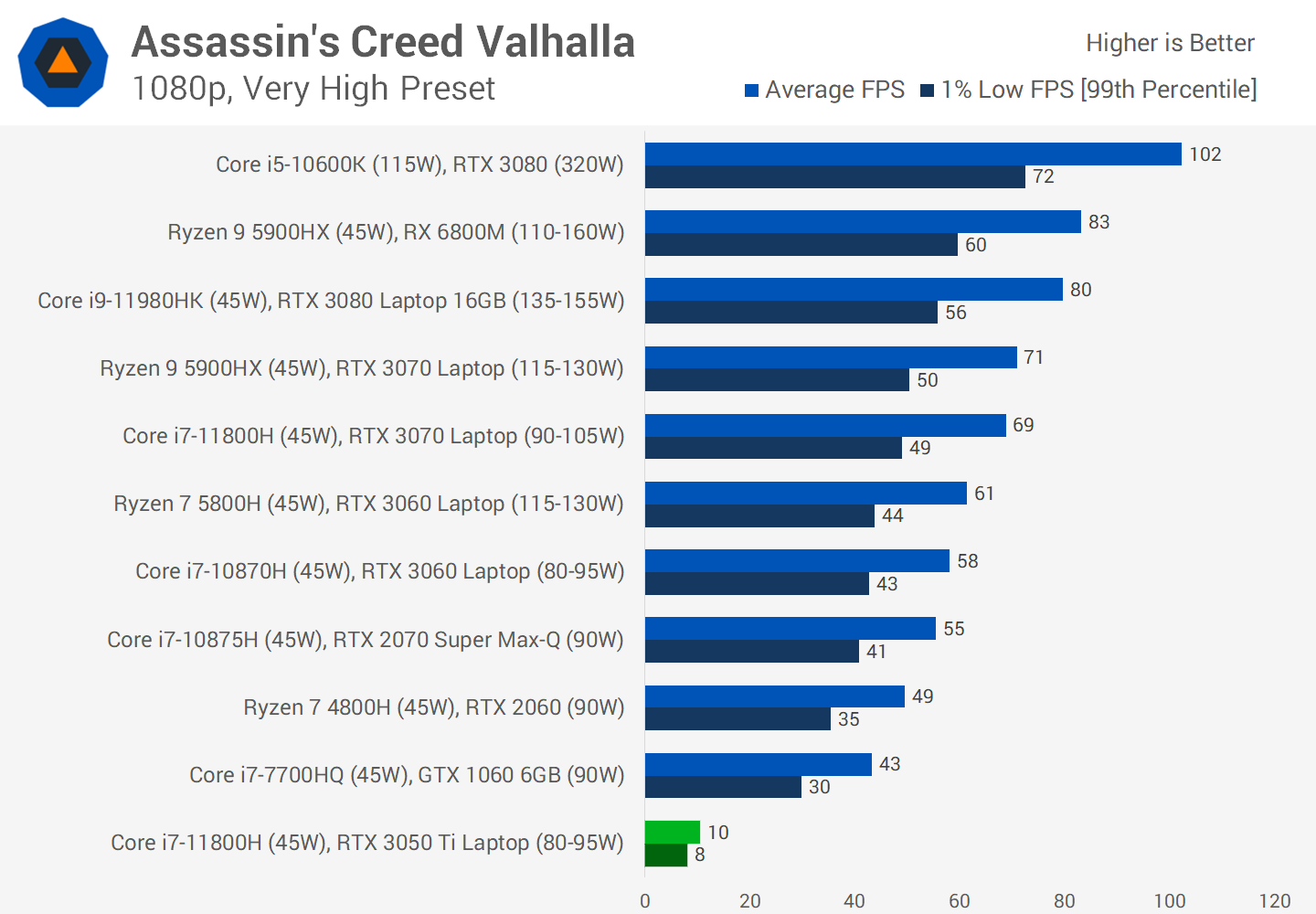

Assassin'southward Creed Valhalla using 1080p Very High settings is a bit of a disaster for the RTX 3050 Ti. These settings present a strong VRAM limitation for a 4GB card like the 3050 Ti, with even the old GTX 1060 6GB delivering better functioning due to its actress 2GB of VRAM.
This shows the issue with Nvidia going backwards on VRAM capacity in this price tier, the GTX 1660 Ti used to offering 6GB but the reduction to 4GB is simply not sufficient for some modern titles like this. And of course the issue is no better at 1440p, with the higher resolution straining the VRAM capacity further.
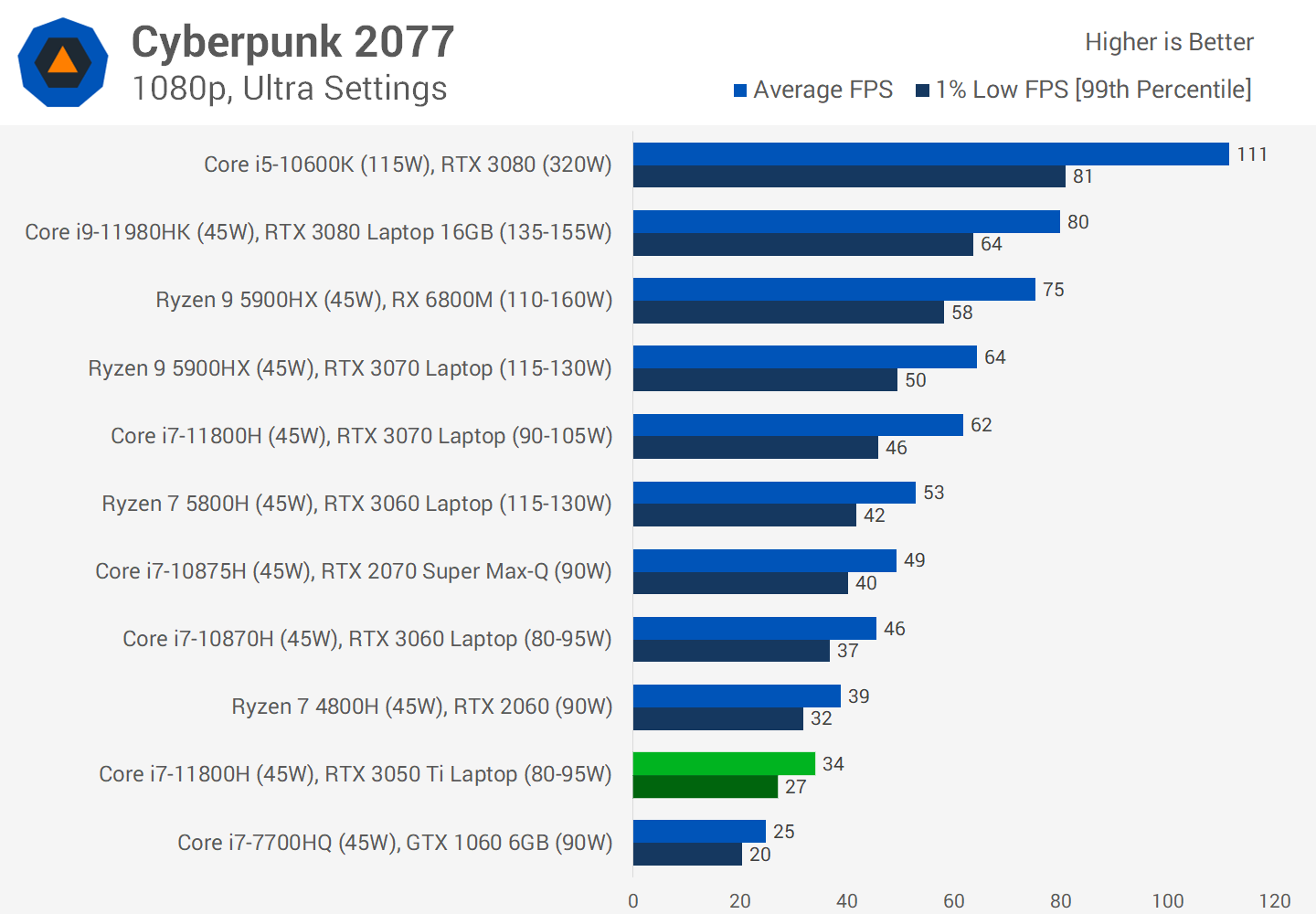
Cyberpunk 2077 is generally not playable on the RTX 3050 Ti using Ultra settings at 1080p, this preset is simply too much for a GPU like this, then I'd strongly recommend reducing to Medium settings. VRAM does play a part in the performance deficit between this GPU and the RTX 2060, however it'south not the same disaster as we merely saw in Assassinator'due south Creed. The RTX 3060 is a much meliorate option for this game and settings combination, offering at least 35% more functioning at a like power level.
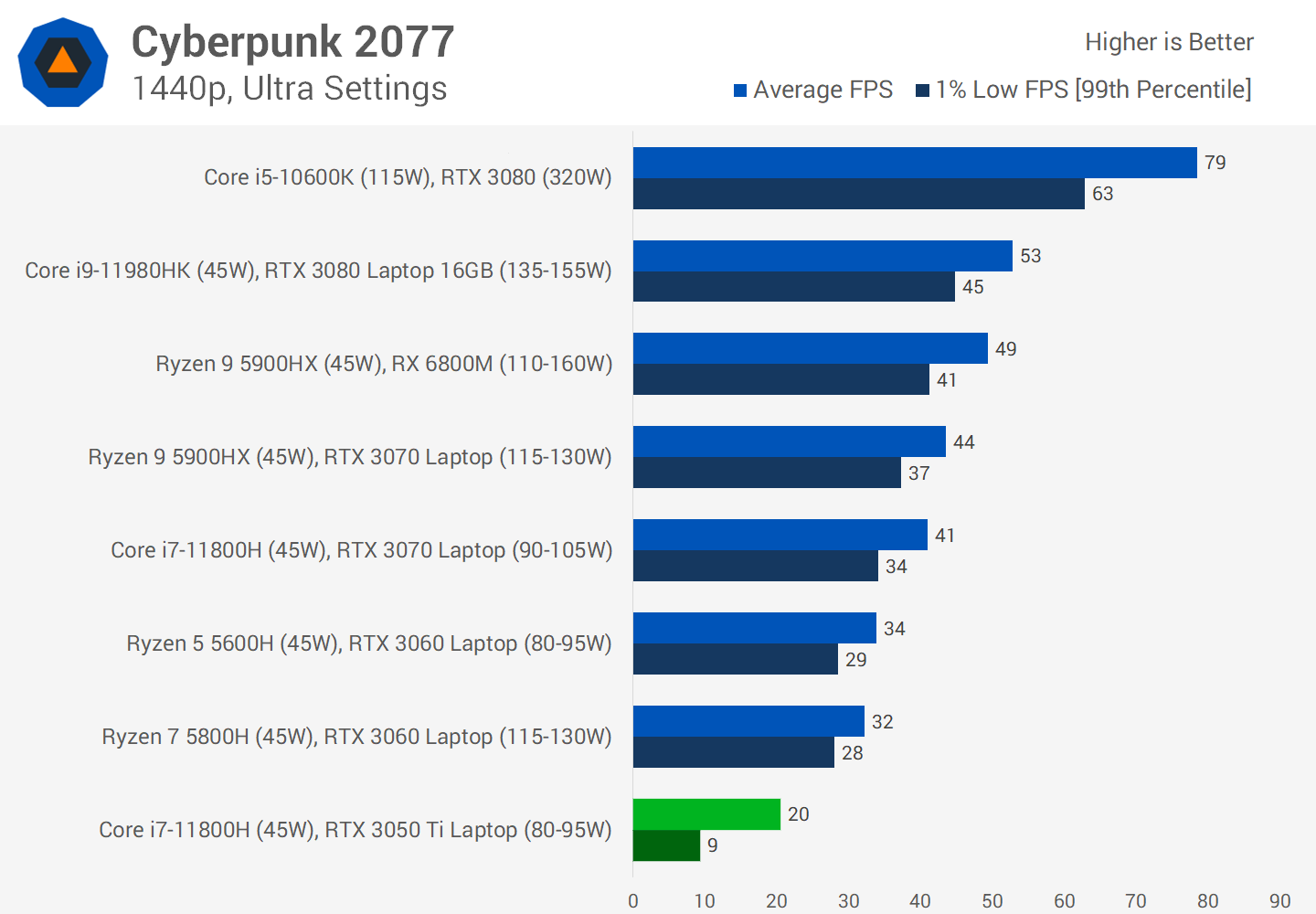
At 1440p in this title, performance falls away even harder, now with a i% low of just ix FPS. This is again due to having but 4GB of VRAM, these settings are right on the border at 1080p and probably limiting performance to some degree, then you move upwards to 1440p and it'due south just likewise much. This also causes issues with ray tracing, as this feature increases VRAM allocation, which in the games I tried like Cyberpunk tends to lead to a heavily compromised ray tracing experience even with DLSS enabled (you're looking at medium or lower settings with minimum level RT).
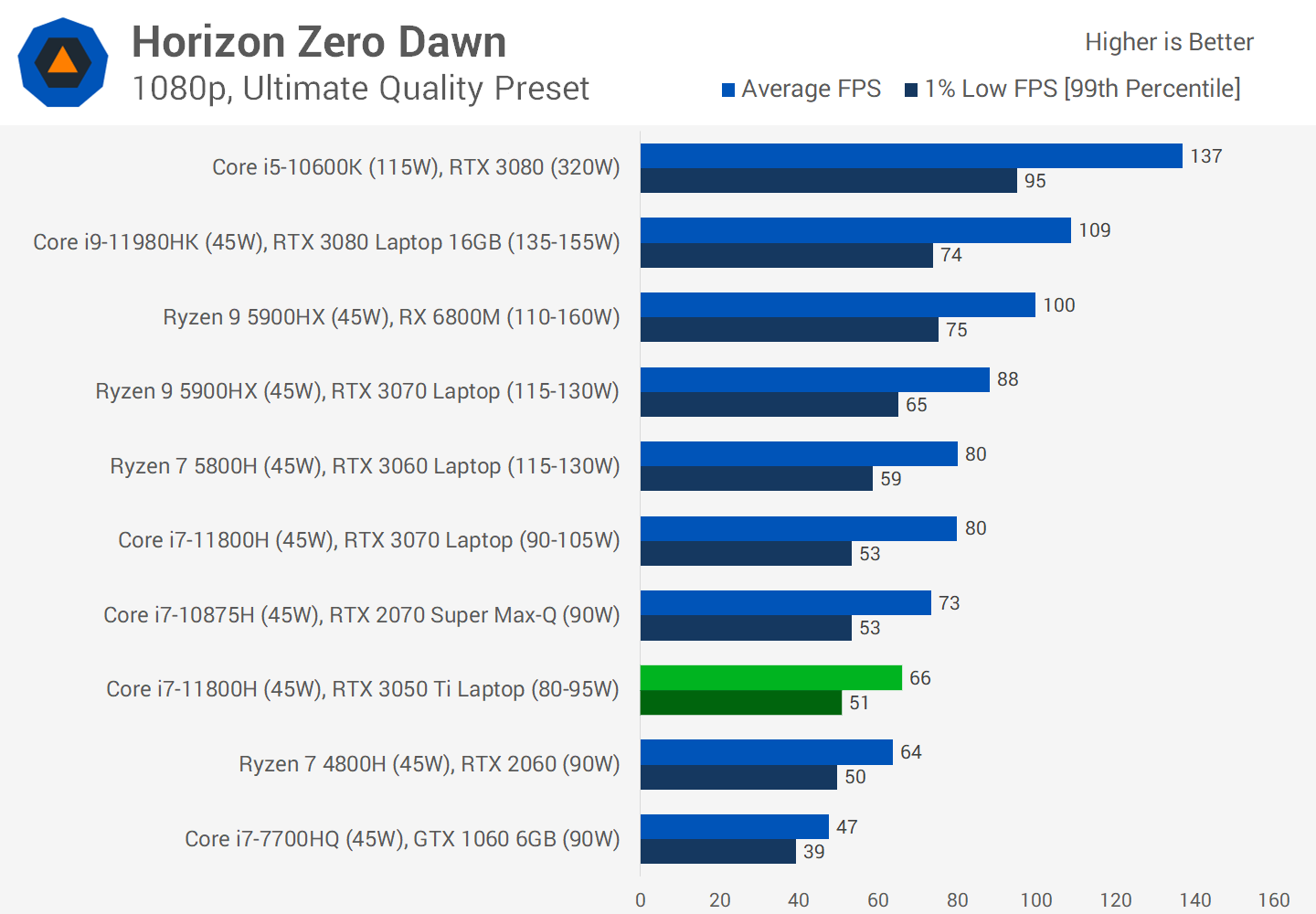
In Horizon Zero Dawn using maximum settings at 1080p, the RTX 3050 Ti is slightly faster than the RTX 2060 90W, delivering a prissy 60 FPS experience on the native laptop display. With that said, performance is eighteen% backside the highest ability configuration of the RTX 3060.
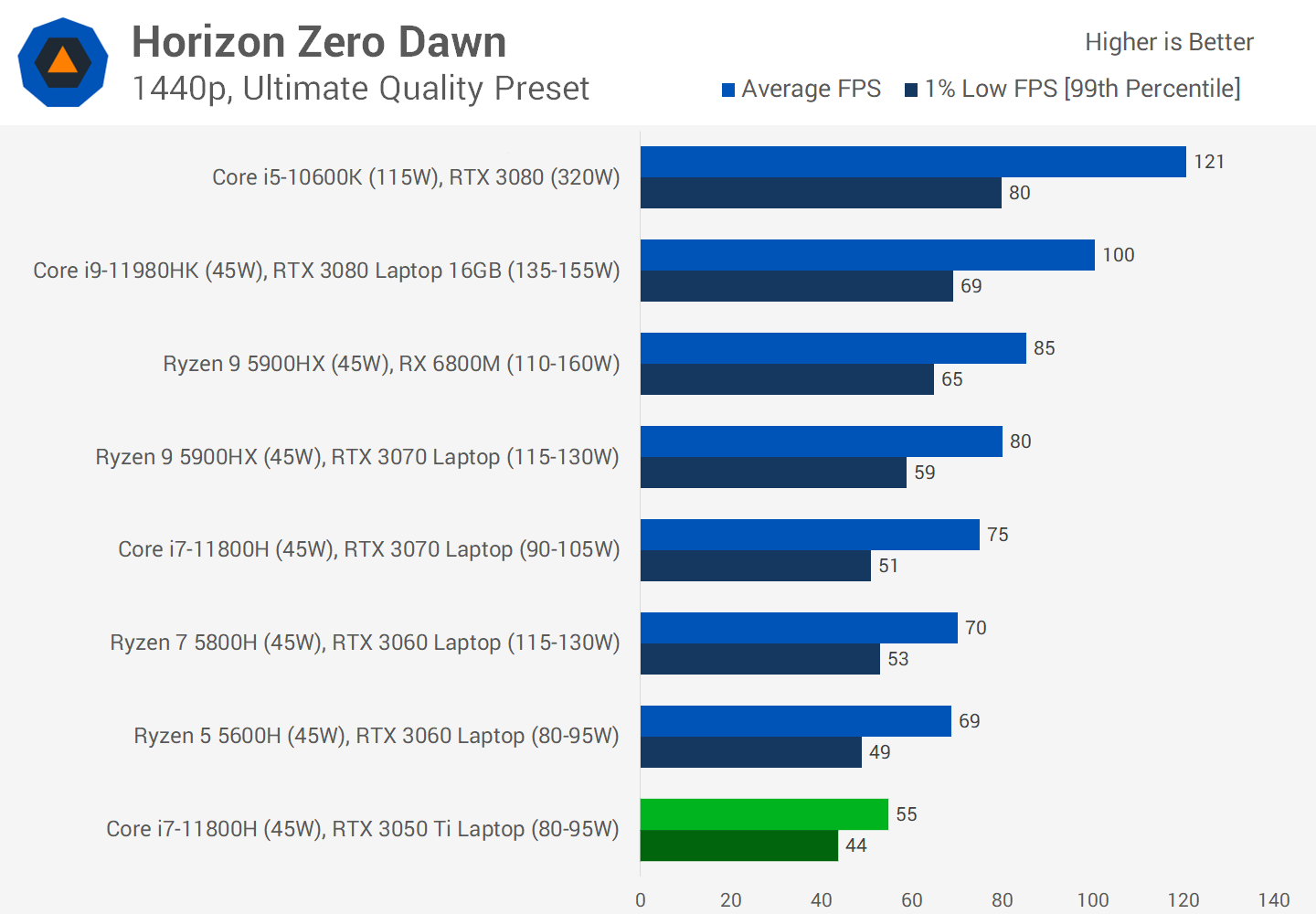
At 1440p, the game is even so playable using the highest settings which is slap-up to see, though you'll have to settle for below lx FPS and ensure you aren't using Optimus.
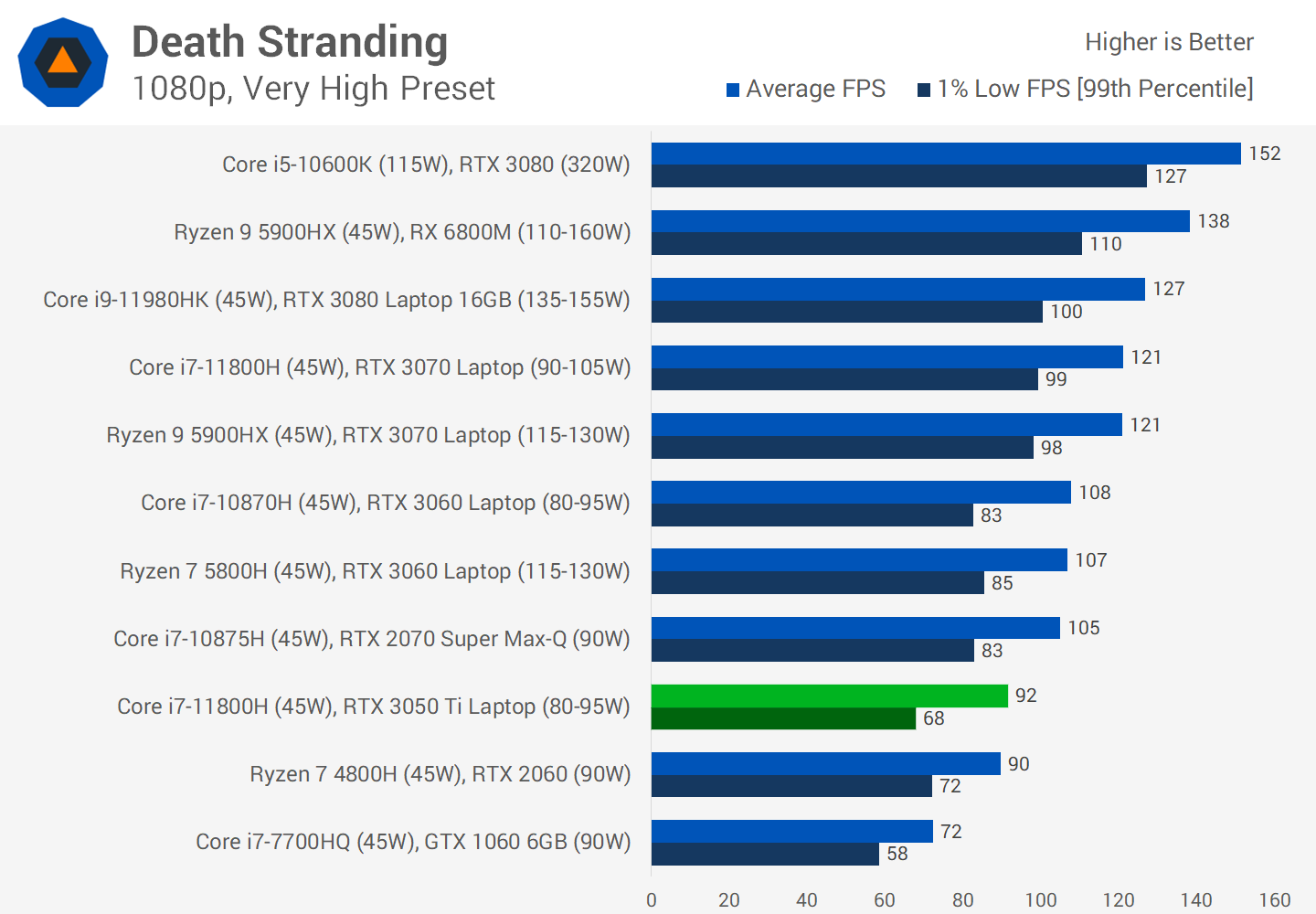
Death Stranding at 1080p shows the RTX 3050 Ti to one time again be very similar in gaming performance to the RTX 2060 90W configuration. This GPU is 15% slower than the RTX 3060 at 80W, and beyond that we showtime hitting CPU limitations with some GPUs.
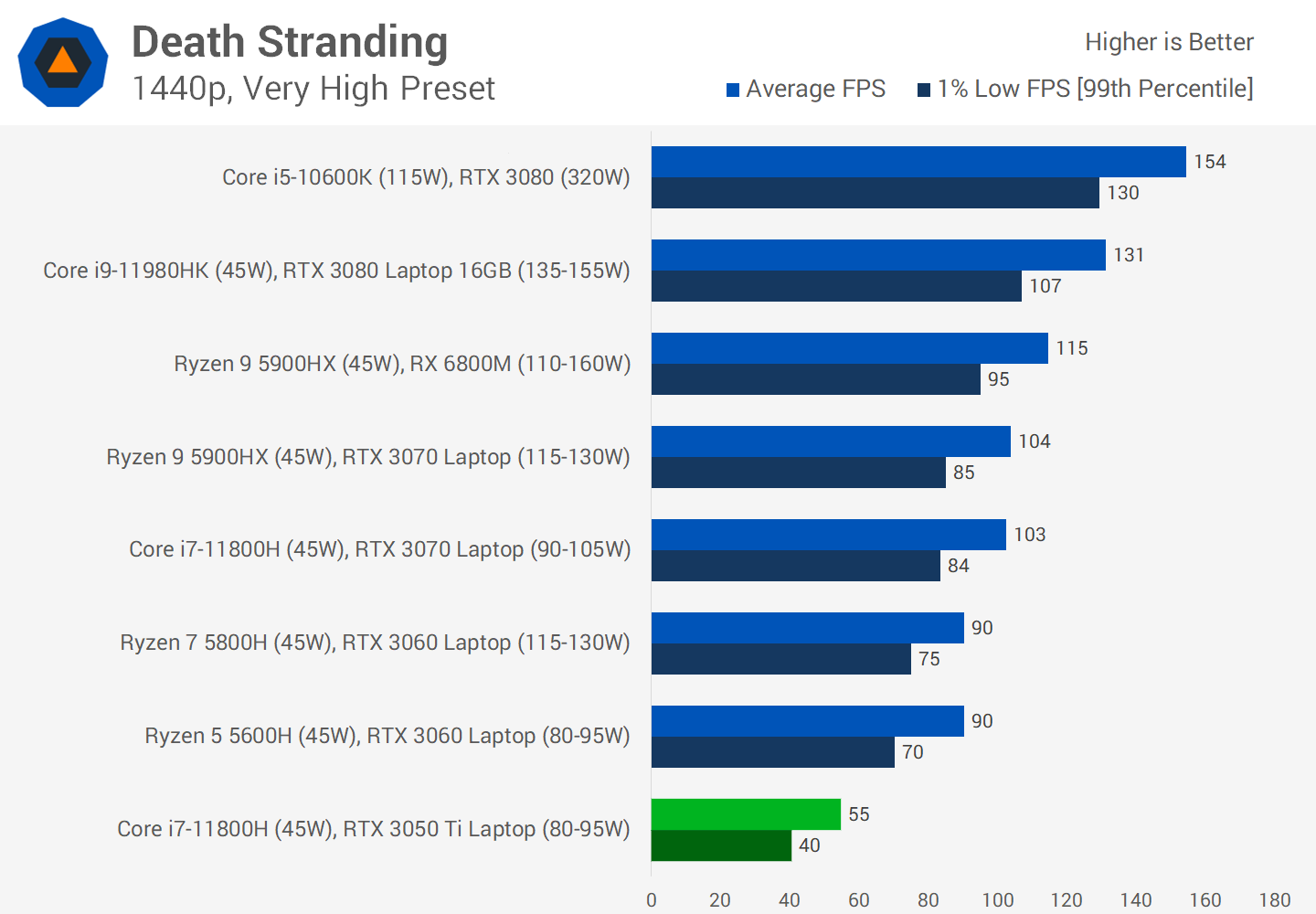
At 1440p, while the game is playable using the Very High preset, functioning is well downwardly from the RTX 3060 in even its base 80W configuration.
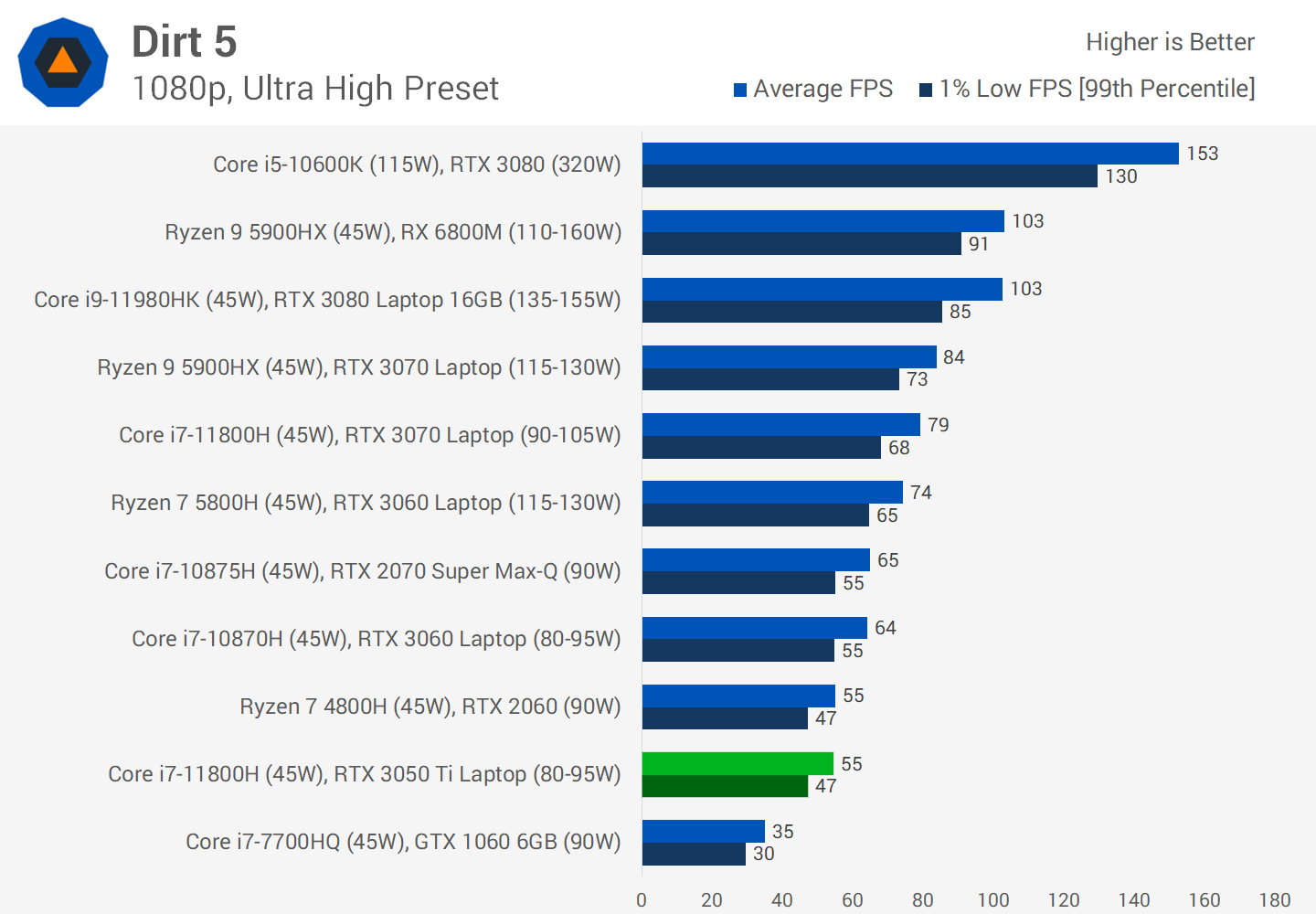
The terminal game nosotros're looking at in detail is Dirt v. In this championship at 1080p using the Ultra Preset, I was able to hit identical functioning between the RTX 3050 Ti and the RTX 2060 at 90W, not bad. Functioning ends up xv% slower than the RTX 3060 80W, and 26% slower than the higher power configuration.
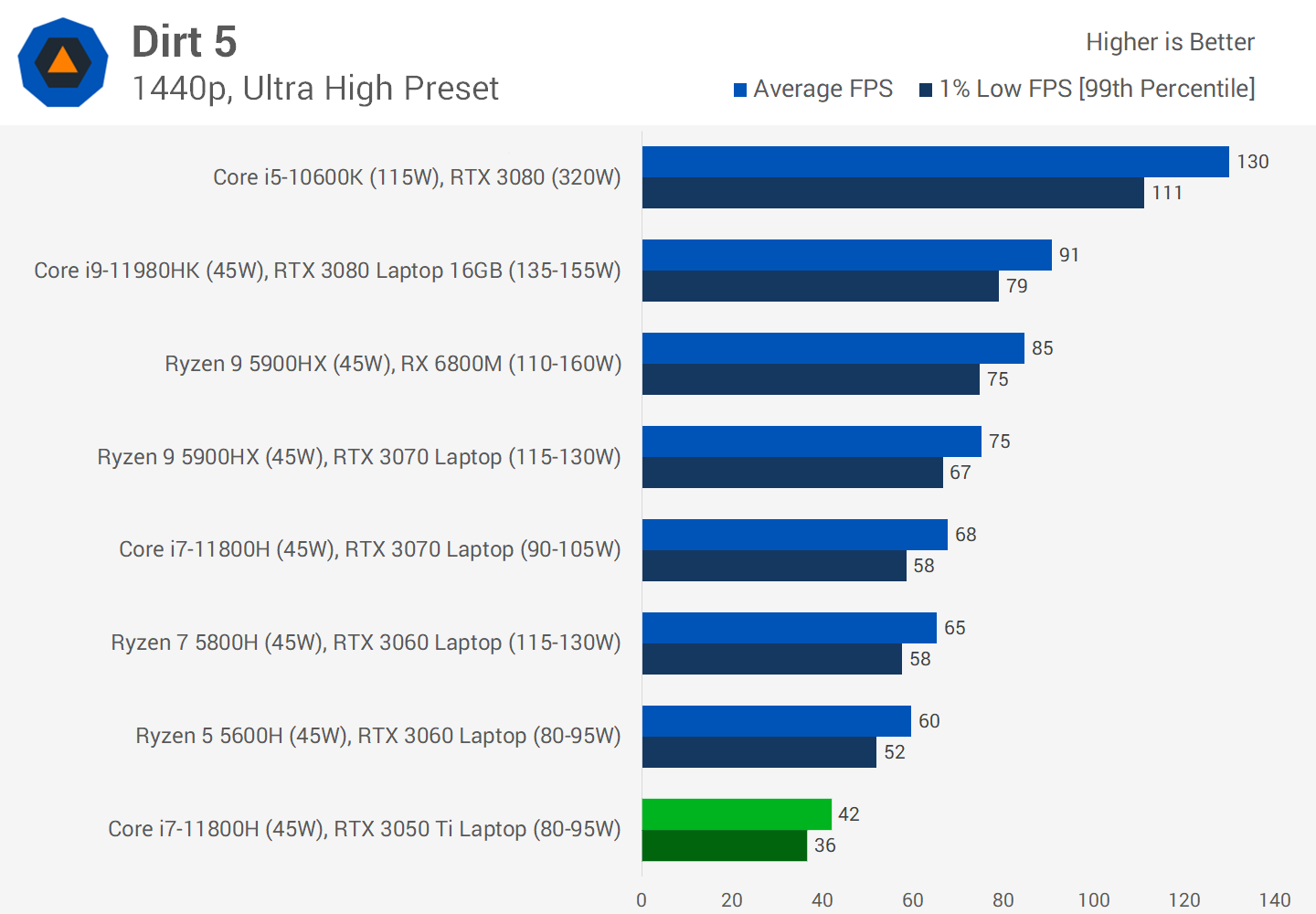
Meanwhile at 1440p, the 3050 Ti does hold up to some degree, though you should await a 40 FPS experience so you lot might desire to lower quality settings.
Performance Comparisons
Looking at some head to head comparisons in the larger suite of games that we tested overall, the end result is that the RTX 3050 Ti is quite similar to the RTX 2060 at a similar power configuration.

In games that aren't VRAM or CPU limited at 1080p, on average the 3050 Ti is within a few percent. Even so, the reduction in VRAM from 6GB to 4GB is a killer in titles like Assassin's Creed Valhalla, Command, and Cyberpunk 2077 with ray tracing enabled – in those games you'll need to plow downwards quality settings, where functioning should be restored to RTX 2060 level, while the RTX 2060 is not express in this way.
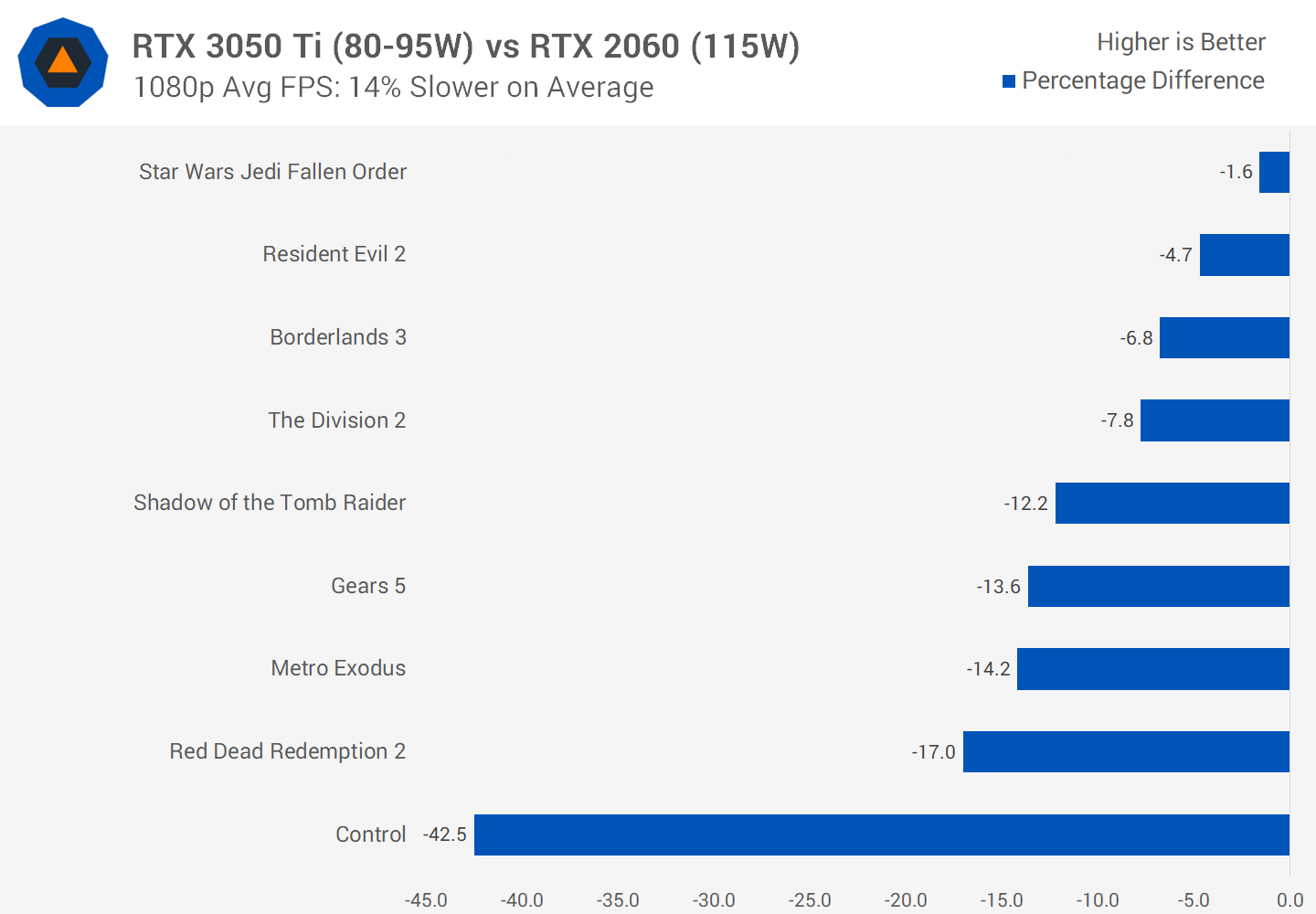
The RTX 2060 was besides available in a 115W power configuration. Using a limited selection of games, the RTX 3050 Ti looks to be around 10 percent slower outside of situations where the VRAM limit comes into play. This gives a valuable look at highest power limit vs highest power limit, though I should note that the majority of 2060 gaming laptops I've seen use either an 80W or 90W limit, non 115W.
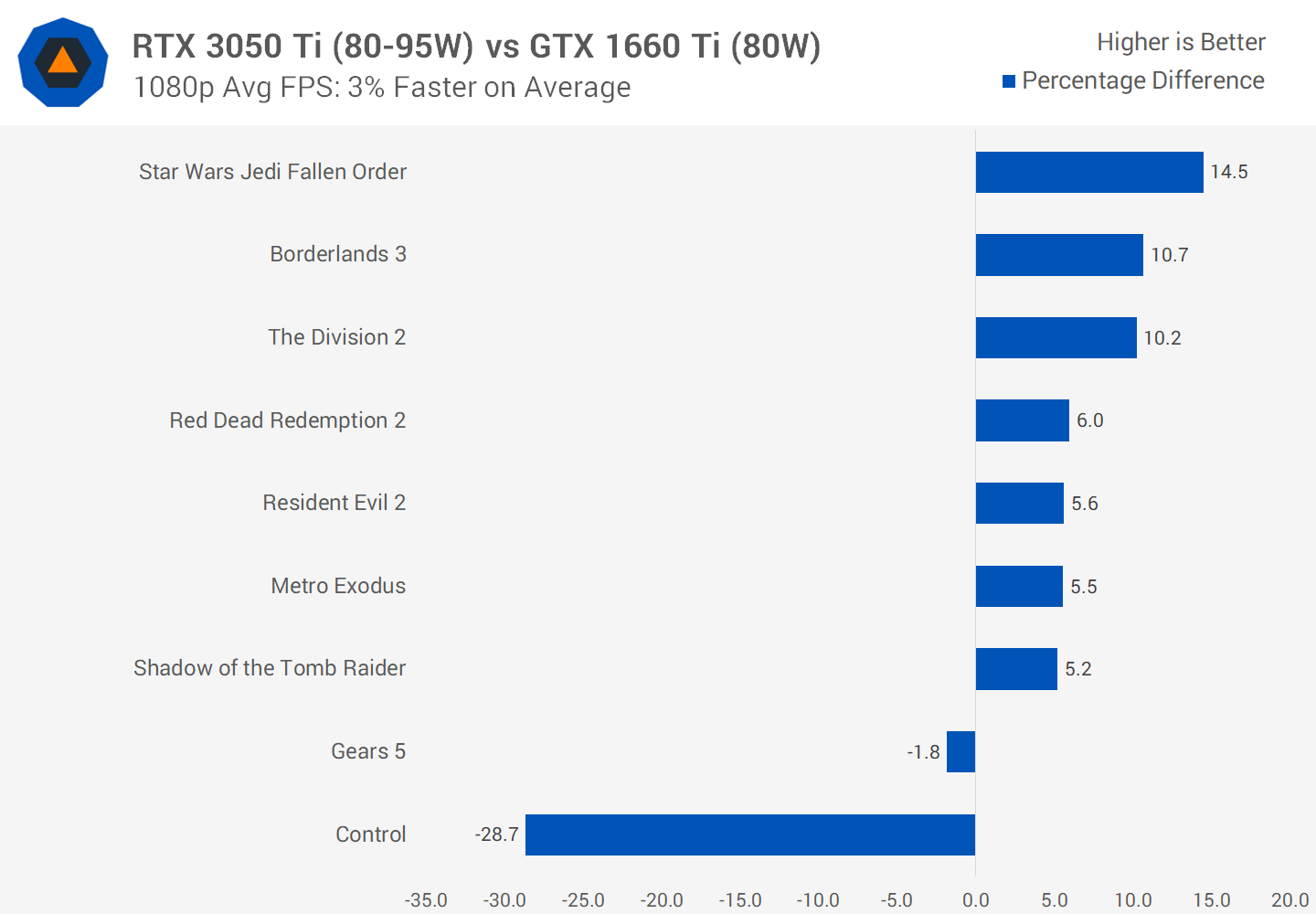
Then when looking at the 3050 Ti vs GTX 1660 Ti, the 1660 Ti previously was in this weird situation where in a lot of games it wasn't that much slower than the RTX 2060 at the same sort of power limit.
When comparing 80W vs 80W, the 3050 Ti was 7 pct faster in a limited selection of games at 1080p, with the best results in the 10%+ range. Though over again, the VRAM limit is something to keep in listen, as the 3050 Ti has just 4GB vs the 1660 Ti'southward 6GB.
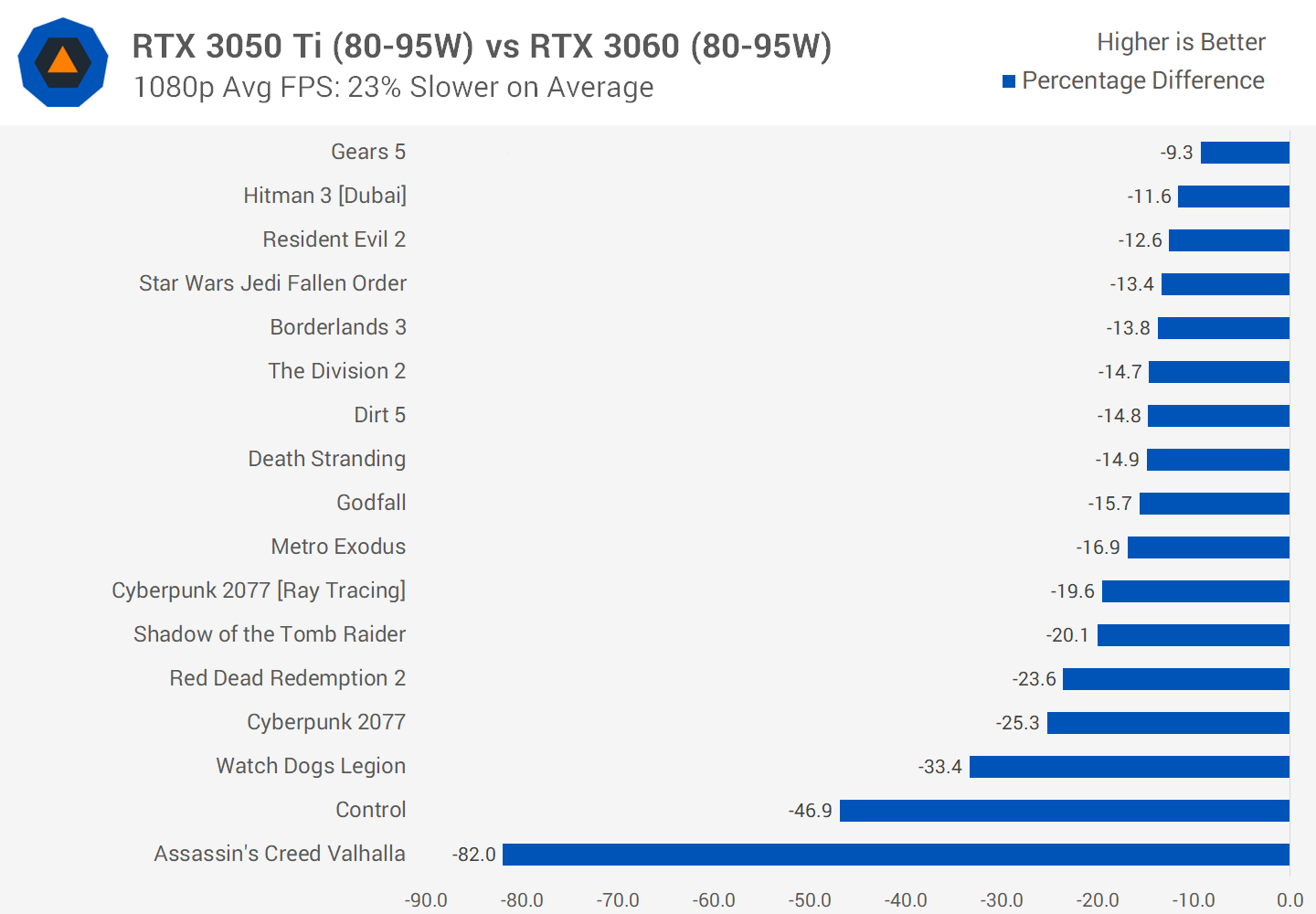
Up against mod GPUs, the 3050 Ti doesn't fare as well. At 1080p, this mainstream GPU was 21% slower on boilerplate than the RTX 3060 configured to a similar power limit. This should give you an idea of the performance differences between the GPUs in a similar laptop chassis congenital for 80W, which should be useful as many laptops come up with options for either GPU. This does include some VRAM express results, without those the margin reduces to roughly 15% slower.
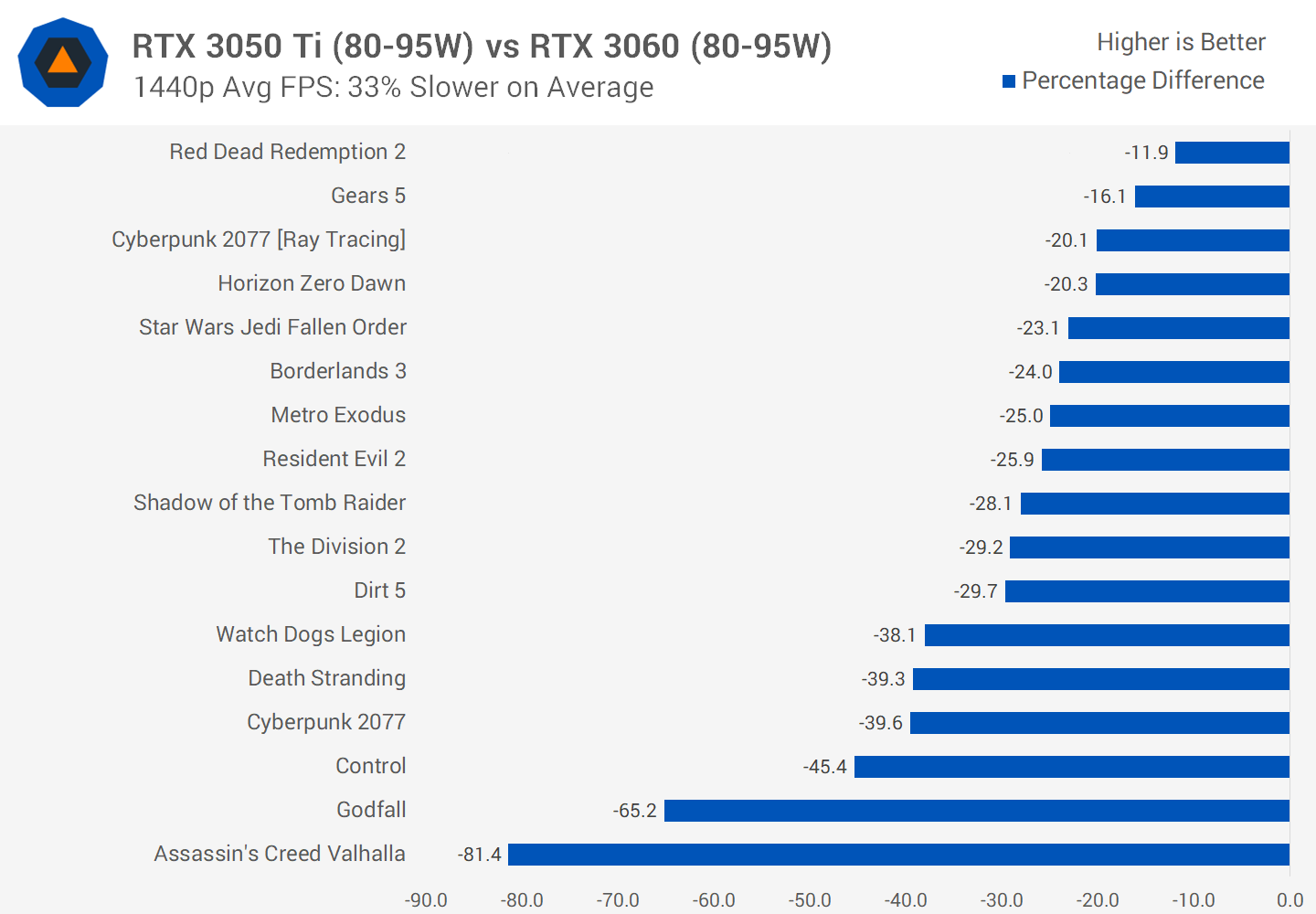
However, the margin grows at 1440p, as again VRAM is a more meaning factor at this resolution. While the RTX 3060 is capable at 1440p, I don't experience the RTX 3050 Ti is as suitable, and generally I'd desire to stick to 1080p display options which is what this sort of GPU was designed for.
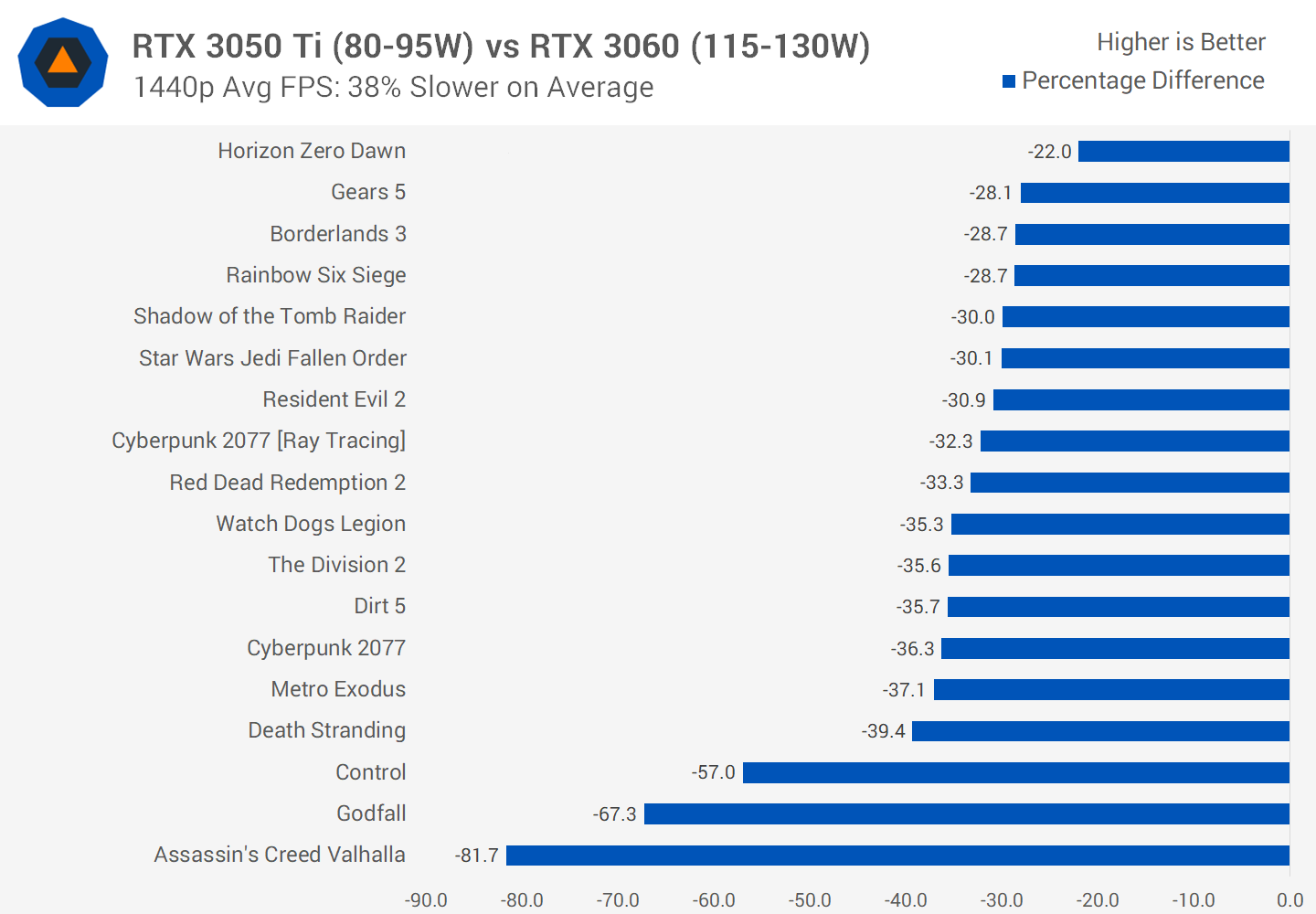
Comparing highest power limit vs highest ability limit, it's a bit of a slaughter for the RTX 3050 Ti, as the RTX 3060 when pushed up to its maximum of 115W is a lot faster. This chart at 1080p shows the RTX 3050 TI as beingness 28% slower on boilerplate, though there are some large outliers in there.
At 1440p it gets fifty-fifty worse, with the RTX 3060's highest power configuration offering 50% better performance outside of VRAM limited titles, or alternatively the RTX 3050 Ti is 32% slower. This is in line with the specification differences.
What We Learned
Starting with the skilful stuff, the GeForce RTX 3050 Ti offers largely the same functioning equally the older RTX 2060 when configured at a similar ability level. This continues Nvidia's tendency of bringing improved performance on the newer generation, usually equivalent to a tier above from the previous gen. The current market makes it hard to make comparisons to previous years, but RTX 3050 Ti laptops should exist cheaper than RTX 2060 laptop launch prices.
The 3050 Ti likewise offers modest functioning improvements over the GTX 1660 Ti in what should be the same price class. At roughly ten% faster, it doesn't make it a must buy if GTX 1660 Ti models are available at a discount, notwithstanding the RTX 3050 Ti does support ray tracing and DLSS, where the GTX 1660 Ti does not.

Newer laptops should also benefit from faster CPUs which have greatly improved over the final few years. Although this is irrelevant to the RTX 3050 Ti GPU itself, information technology is a consideration when focusing on specific laptop models.
On the less stellar side, using but 4GB of VRAM feels inadequate for the performance level this GPU provides. Being RTX 2060-similar in performance means the 3050 Ti should have no problem with 1080p gaming at Ultra settings, and for the virtually part that's truthful -- unless texture sizes exceed the VRAM buffer, which is reduced from 6GB to 4GB of GDDR6 relative to the 2060. In some games that is insufficient even at 1080p, permit lonely in the time to come which will most certainly see even more VRAM usage.

Now, there is a place in the market for 4GB VRAM cards, entry-level options like the GTX 1650 is ane example where it makes sense, as you'll frequently be playing on medium setting every bit the GPU overall isn't powerful enough for Ultra. But the RTX 3050 Ti is much faster than the GTX 1650, opening the door for gaming at higher quality settings or resolutions, where 4GB can bottleneck the carte before the CUDA cores are saturated.
The VRAM reduction in this price category also hurts ray tracing, which tends to classify more than VRAM than traditional rasterization. It'due south nice to bring ray tracing to lower price tiers, only there's not much point when you don't provide enough VRAM to cope with its increased demands (or fifty-fifty patently rendering for that affair).

The RTX 3050 Ti also faces strong contest from Nvidia'southward own line-up. The RTX 3060 is much faster, offer ~35% more operation at a similar 80W power level, or 50% more than when the RTX 3060 is configured at its maximum 115W limit. That's a much larger margin than in higher tiers, where something like the RTX 3070 is only 20% ahead of the 3060.
With the RTX 3060 ordinarily costing $100-200 more than in an otherwise equivalent laptop, the RTX 3060 is a much improve deal for gamers as you go the VRAM heave and a big functioning jump. Look hard plenty and yous can notice decent mainstream or mid-range gaming laptops with this GPU without having to go too high-end.
That's the existent stinger for those hoping for something nifty value that's worth buying in today's market. For less gaming centric laptops, the RTX 3050 Ti remains a solid GPU, but it's not landing that value sweet spot some were hoping for.
Shopping Shortcuts
- GeForce RTX 3050 Ti Laptops on Amazon
- GeForce RTX 3060 Laptops on Amazon
- GeForce RTX 3070 Laptops on Amazon
- Core i7 Tiger Lake Laptops on Amazon
- Ryzen 7 5800H Laptops on Amazon

Source: https://www.techspot.com/review/2297-geforce-rtx-3050-ti-laptop/
Posted by: williamsonobts1960.blogspot.com
0 Response to "Nvidia GeForce RTX 3050 Ti Laptop GPU Review"
Post a Comment